
Trading Futures: Art Music at a Crossroads
Written for and published by the Boston Musical Intelligencer on 30 July 2026
As Tanglewood’s 2026 Festival for Contemporary Music ended Tuesday, the TLI (Tanglewood Learning Institute) offered a fitting capstone discussion between composers Esa-Pekka Salonen and Gabriella Smith this Tuesday entitled: “Shaping Sound.” This fascinating conversation at the Linde Center for Music and Learning replaced the originally scheduled one set to occur between Chad Smith, CEO and Salonen, entitled: “The Future of the Symphony Orchestra.” Citing a “family medical emergency,” Smith was quickly replaced with a new respondent and topic, one that was no less fascinating and future-forecasting. The ensuing 45-minute conversation balanced lofty ideology alongside a feel-good indecisiveness on the future of art music in an age of complexity.
Salonen, serving as moderator, opened the session with a quip and juxtaposition, noting that he and Gabriella represent two different sides: that he “used to be the future of music, and [she] is the future of music.” Focus then re-centered on a brief retrospective of the musical past before a future-oriented trajectory.
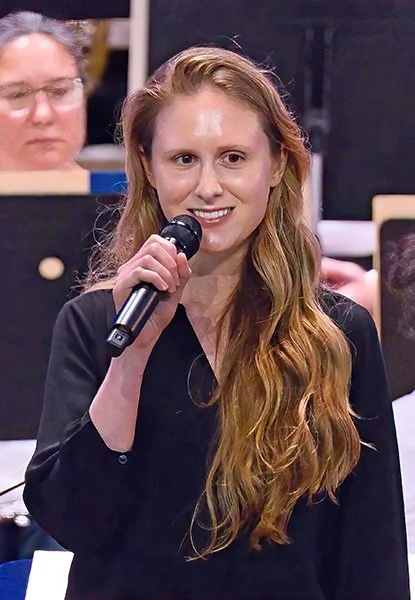
Gabriella Smith in 2025 (Hilary Scott photo)
Music history was reduced to two key elements: technological innovation and historical events. These two elements, as a confluence of factors, were claimed as the main impetus for style and change. To make the point, Salonen cited Bach and equal temperament, Beethoven and the “Eroica” Symphony as a reaction to Napoleon, the development of piano technology and his landmark sonatas, Verdi with the Resorgimento and Sibelius with Finnish Nationalism, as composers whose art created unintended associations; the First World War marked the end of Romanticism and the Second, the establishment of European modernism. He spoke of Serialism in the context of how Darmstadt, the Baroque city bombed to rubble, became the musical phoenix from which a new of modernist musical ethic arose. His groundwork laid, Salonen then queried Smith: which landmark events had shifted the “trajectory of [her] compositions?”
For Smith, climate change and its effects have concentrated her style around community and ecological action (specifically her efforts in transforming an old airbase in Seattle with friends). Art as activism? Both agreed that the lines are blurred and for the better; there is no longer a distinction between the two.
Salonen spoke of how his experiences with the activist approach have ranged from the “mixed to the downright bizarre.” He referred to a philanthropic gala concert he had been invited to conduct in Geneva’s Casino. A simple and unobjectionable task, the fundraising event was to support starving children in Africa. The who’s who of European society, and all manner of wealthy celebrities, were there for the classical music concert and subsequent posh dinner sponsored by Philip Morris Tobacco. The contrast could not have been greater.
Salonen then levied a critique of nomenclature, questioning whether “classical, in reference to class, the specific “Classical” era, or Classical Greece” was even appropriate. “I find it quite sad actually that this music we represent . . . [is not] more part of the discourse” and that the “rock and pop people who do these aid concerts” are more effective at engaging large audiences in the cultural marketplace of ideas. Western art music would be better served if it engaged more with the outside world, interacting with it, all the while maintaining aspects of its insular “ivory tower” culture.
“Sitting alone writing music seems so inconsequential to everything that we are facing,” Smith said in response. “Music is part of our culture . . . [writing it and making it] is a way to bridge that gap between wanting to be part of something bigger and taking action.”
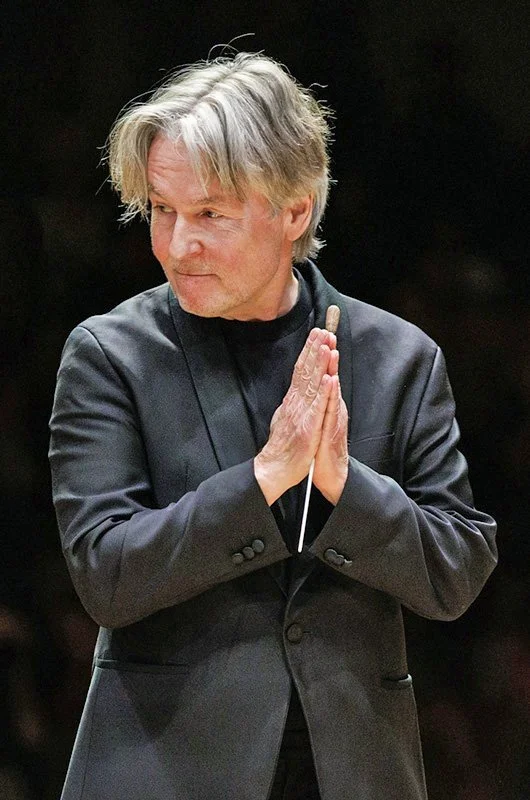
Esa-Pekka Salonen at Symphony Hall (Robert Torres photo)
Shifting the conversation to the music itself, Salonen described the “strictly modernist milieu” of his upbringing: Serialism, Darmstadt, and the dogma of the “gurus” (i.e. Boulez). Taboos and the moralization of music-making were the fad of the age. All previous methods of compositional technique were to be avoided. Modulation, harmony, melody, rhythm, pulse? “No, no.” The journey of most composers of Salonen’s generation was to get out of that normative, Serialist “straitjacket” and to reclaim “access back to those powerful tools [of the past],” those timeless fundamentals of music.
Smith asserted that most composers of her (younger) generation “don’t worry about writing tonal music or not; we write the music that we write.” In her view, it is not a matter of “choosing between styles but incorporating whatever she likes and is inspired by.” Salonen then told another humorous personal anecdote of Pierre Boulez backstage; in reference to Schoenberg’s Op. 31, he said that “. . . the 12-tone system is totally ridiculous, and I have witnesses.” When asked if he was denouncing the Serialist language, Boulez responded “perhaps.”
For composers of Salonen’s boomer generation (he is 68), style was a moral choice, an ethical choice, but today, he asserts that the contemporary musical language is more playful and less conformist. Smith agreed.
But back to technology as an impetus for stylistic change, Smith provided detail on her compositional technique. She begins all her compositions by improvising on the piano or violin, playing and recording all the parts of the score, and then using software she “fills in the gaps with notation and transcribe[s] at the end.” The origin of her technique dates to age 18 when, at the Curtis Institute, she was tasked with providing musical tracks for a new original work so that the local dance school could choreograph to the recording. Never having used digital recording tools, her present technique was born from necessity – even if the initial assignment resulted in choreography made to the errors of a corrupted sound file.
Moving the conversation to the elephant in the room, Salonen broached the topic of A.I. and music. “Things are changing so quickly, I have not had any success in having A.I. help me so far,” stated Smith, in reference to asking ChatGPT to write (bad) program notes. Salonen then detailed the fundamental disconnect in working with LLMs (large language models), in that one needs to “describe” musical sounds that can only be made in reference to existing styles, thus making it improbable to create something anew with a coherent method or musical language — one might even say the “soul” of a composer. The machines need ridiculous parameters such as: “I want to have 47 minutes of “chill” exercise music: 19.6 percent Taylor Swift: 7.3 percent Beethoven; etc., and a little bit of Ed Sheeran, Ligeti, and all with the voice of Maria Callas.” Nothing more than a “party trick,” real creative coherence is primitive at best. “We’re safe for the time being.”
In a slight non sequitur, Salonen invited Smith to discuss their mutual interest in fish, that is, the plainfin midshipman (Porichthys notatus) and its singing abilities incorporated into their respective compositions. Smith and Salonen share this affinity for harvesting sounds from the natural world for use in their compositions. And thus, the point of the whole conversation: the scope of sonic material has expanded beyond the conventional use of instruments to the embrace of the world’s sounds: “Everything that we [composers] write is influenced by everything that we have heard or listened to,” but one cannot control the evolution of style and sound, as these are organic matters that evolve with a fluid trajectory.
Salonen closed with reference to the “reformation” of the historically informed performance movement and the futility of recreating an “authentic” performance based on research, techniques, etc. “There is no way we can hear it the same way. There is no such thing as “authenticity,” really.” The point of performance, according to Salonen, is something far more interesting than authenticity; it is to communicate something beyond language, something deeper, that affects how people feel, and hopefully inspiring each of us to ask the right questions.
What then is the point of the Western art music canon but this discourse and engagement with the “right” questions? Perhaps it is this probing curiosity, this audacity to ask the difficult questions — of the heart and the mind — and to engage with the un-sculpted marble of “the truth,” that this art form continues to thrive as an endless font of renewal and re-creation.